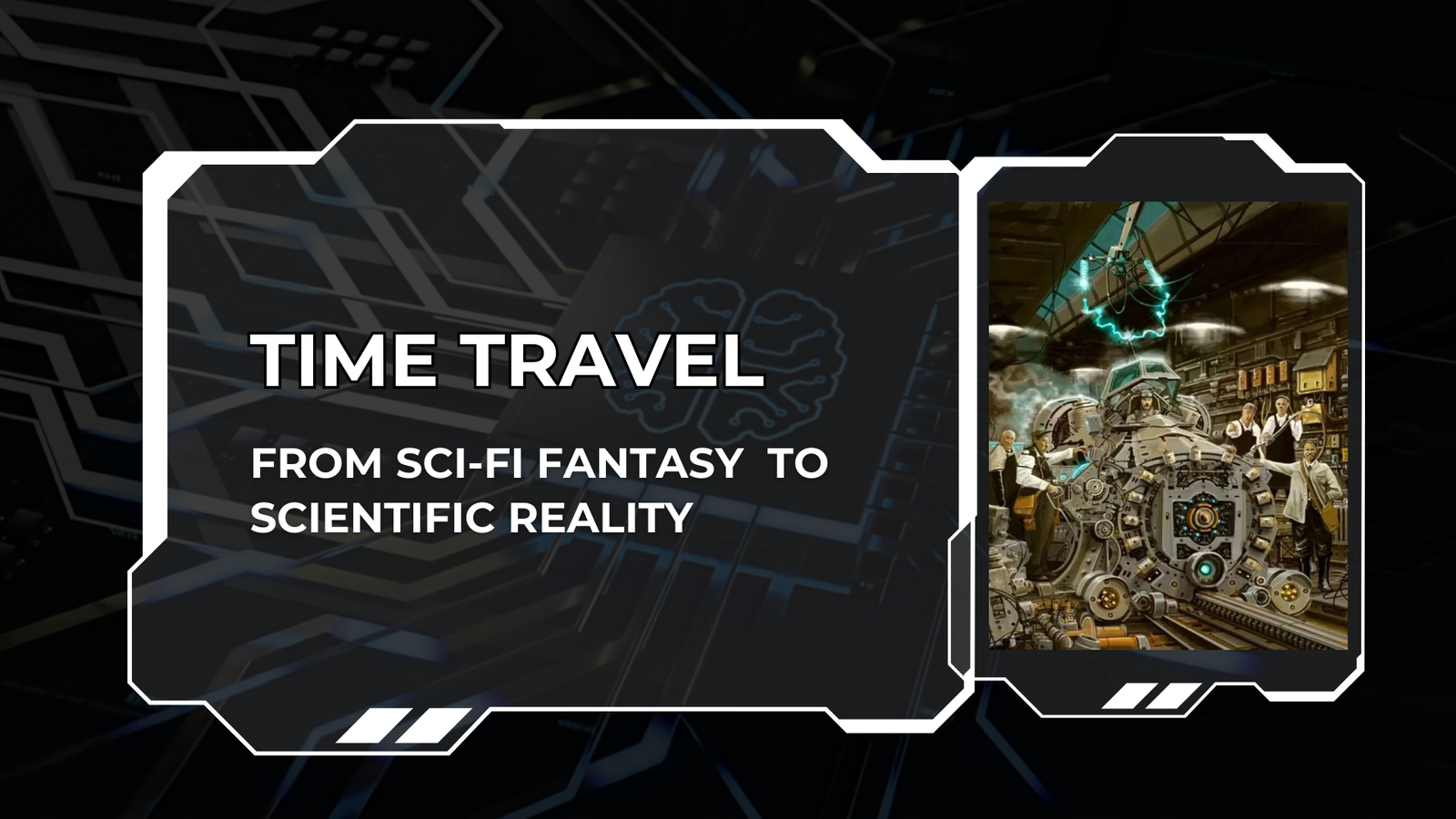
Time travel has long captured humanity’s imagination, mixing the fantastical with the theoretical in an exciting dance of possibility. From the pages of science fiction novels to the screens of blockbuster movies, the concept has fueled countless narratives about navigating the fabric of time. Yet, beyond its fictional appeal lies a growing field of scientific inquiry exploring whether time travel could transition from fantasy to reality. This article delves into the origins of time travel in popular culture, the scientific principles underpinning its plausibility, and its challenges and implications for humanity.
The Origins of Time Travel in Popular Culture:
Time travel as a literary and cinematic subject matter dates back centuries, presenting a canvas for exploring human interest in the past and destiny.
Early Literary Explorations:
The first seeds of time travel appeared in early literature, considerably in H.G. Wells’ The Time Machine (1895). This groundbreaking novella introduced the concept of a mechanical device allowing time to travel, fascinating readers with its resourceful opportunities. Jules Verne, every other pioneer of speculative fiction, dabbled in subject matters of temporality, albeit without delving into explicit time travel mechanisms.
Hollywood and Mainstream Popularity:
The rise of cinema in the twentieth century projected time travel into mainstream recognition. Films like Back to the Future and The Terminator introduced the idea with adventure and instructive stories, reflecting humanity’s fascination with altering records or shaping the future. The television collection Doctor Who further cemented time travel as a staple of technological science fiction, blending leisure with philosophical inquiry.
Scientific Foundations of Time Travel:
While time travel has long been relegated to fiction, scientific theories advocate it might not be as incredible as one idea.
Einstein’s Relativity: The Gateway to Time Travel:
Albert Einstein’s idea of relativity paperwork the cornerstone of modern-day physics and gives a theoretical foundation for time travel.
- Special Relativity and Time Dilation: According to big relativity, time is not a constant; it slows down for gadgets shifting at speeds near the rate of light. This phenomenon, called time dilation, means that astronauts visiting at close to mild speeds should age more slowly than humans on Earth, a form of head-time travel.
- General Relativity and Wormholes: General relativity extends these concepts, suggesting the existence of wormholes, or “Einstein-Rosen bridges,” that might connect distant points in area-time. If traversable, these tunnels may want to theoretically allow instantaneous travels throughout time and area.
Quantum Mechanics and Time Loops:
Quantum mechanics adds some other layer of complexity. Concepts together with quantum entanglement and superposition venture into our traditional information of motive and impact. Theoretical physicists, along with Kip Thorne, have posited that closed time-like curves (CTCs) may allow travel to the beyond, even though they boost paradoxical questions about free will and causality.
Paradoxes and Challenges of Time Travel:
For all its allure, time travel confronts substantial paradoxes and technical challenges that continue to be unresolved.
Temporal Paradoxes:
Time travel to the beyond introduces paradoxes that venture the consistency of activities:
- The Grandfather Paradox: If one were to travel again and prevent their grandfather from assembling their grandmother, it would negate their existence, creating a logical contradiction.
- The Bootstrap Paradox: This arises when an item or piece of statistics is sent again in time, creating a loop in which its foundation cannot be decided. For example, a book sent back in time conjures up its very own writing.
Energy Requirements and Stability:
Theoretical models of time travel, together with the ones concerning wormholes, require sizable quantities of energy, probably exceeding what’s bodily possible. Additionally, maintaining wormholes stable might also necessitate individual count numbers with bad energy density, a substance now not but located.
Modern Scientific Advances and Experiments:
While true time travel stays theoretical, modern studies have made strides closer to knowledge of its feasibility.
Particle Accelerators and Time Dilation:
Experiments with particle accelerators have proven time expansion on a microcosmic scale. Particles shifting near the velocity of light exhibit slower decay costs, consistent with Einstein’s predictions. Though far from permitting human time travel, these findings verify that point dilation is an actual, observable phenomenon.
Simulating Time Loops in Quantum Systems:
Recent studies in quantum computing have simulated time loops to recognize their implications. For instance, researchers have modeled eventualities equivalent to closed time-like curves to explore their effect on quantum states, conveying insights into the essential nature of time.
Philosophical and Ethical Implications of Time Travel:
The prospect of time travel transcends scientific inquiry, referring to profound philosophical and ethical questions.
Causality and Free Will:
Time travel demands situations the linearity of cause and effect, raising questions about loose will and determinism. If the future can affect the past, does that suggest our picks are predetermined? Or can change timelines exist, branching into infinite possibilities?
Moral Dilemmas:
Time travel to the past poses moral quandaries. Should one intrude in historical activities to save you tragedies, knowing it’d modify the present in unpredictable approaches? Similarly, destiny time vacationers would possibly face ethical worries approximately influencing modern society.
Time Travel Inside the Context of Multiverse Theory:
One manner to resolve paradoxes is through the multiverse principle, which indicates that each action lays a new, parallel universe.
Alternate Timelines:
In a multiverse state of affairs, traveling to the past can create a divergent timeline rather than altering the traveler’s unique truth. This concept, explored in films like Avengers: Endgame, gives a workaround to the logical inconsistencies of conventional time travel.
Implications for Reality:
If time travel creates parallel universes, it increases questions about the character of reality and whether or not our universe is however considered one of countless others. Such possibilities mission our information of identity, continuity, and existence itself.
Future Prospects for Time Travel:
Despite its challenges, time travel remains a compelling field to take a look at with ability destiny breakthroughs.
Technological Innovations:
Advances in technology, consisting of greater effective particle accelerators and quantum computers, can additionally release new insights into the fabric of space-time. These innovations could lead us towards knowledge of whether the time journey is possible.
Interstellar Exploration and Relativistic Travel:
The improvement of spacecraft able to near-light-velocity travel would permit ahead-time travel on a sensible scale. While a long way from creating wormholes or closed time-like curves, such development would represent a considerable step towards making time travel a reality.
The Role of Imagination in Scientific Progress:
Science fiction has long inspired scientific advancements. It is a starting point for new ideas.
The Impact of Stories on Science:
Stories of time travel sparked interest in physics and cosmology. It inspired generations of scientists to explore the frontiers of possibility. When considering the characters, concepts such as space elevators and artificial gravity were considered. Gain credibility with advances in engineering and physics.
It Promotes Curiosity and Creativity:
By imagining what could be Time travel stories challenge us to think outside of our current knowledge. This spirit of curiosity drives scientific discovery and innovation keeping humanity’s sense of wonder alive.
Conclusion:
Time travel occupies a unique space at the intersection of science and imagination, blending speculative fiction with precise inquiry. While its realization remains uncertain, the pursuit of understanding time travel offers valuable insights into the nature of reality, the limits of human creativity, and the interconnectedness of past, present, and future. Whether as a scientific frontier or a creative muse, time travel continues to inspire humanity to dream big and question the boundaries of what is possible.
FAQs:
1. Is time travel scientifically possible?
While time travel to the future is theoretically possible through relativistic effects like time dilation, traveling to the past remains speculative and faces significant challenges.
2. What are the biggest obstacles to time travel?
The main challenges include resolving paradoxes, meeting immense energy requirements, and the need for exotic matter to stabilize wormholes.
3. Has time travel been proven in experiments?
Time dilation has been observed in particle accelerator experiments, confirming Einstein’s predictions. However, no experiment has demonstrated backward time travel.
4. Could time travel create alternate realities?
According to the multiverse theory, time travel might create parallel universes rather than altering the existing timeline, offering a potential solution to paradoxes.
5. How does time travel relate to wormholes?
Wormholes, as predicted by general relativity, could theoretically connect different points in space-time. If traversable, they might enable time travel.
6. Why is time travel a popular theme in fiction?
Time travel captivates audiences by exploring universal themes like regret, ambition, and the desire to change one’s destiny, making it a compelling narrative device.